 Case study
Tulr: one workspace for the tools teams duct-taped together.
At Tulr I designed a pre-LLM no-code builder that combined videos, tables, forms, and calendars with automation—a one-shot replacement for Airtable, Typeform, Calendly, and Loom.
Role
UX Designer
The brief
Four primitives, one composable builder.
Tulr.io let teams combine videos, tables, forms, and calendars, then layer automation on top to build internal apps without writing code. It shipped in the early no-code wave—before LLMs made "describe your app" the default onboarding pattern.
I joined as UX designer at AuthMe Id Services, working with founder Shardul Lavekar and a team of seven developers to design the mobile and web builder, a 700+ component library, brand system, and Product Hunt launch.
01 · The builder
Teach four product metaphors inside one canvas.
Spreadsheet, form, scheduler, and async video each carry their own mental model into the same builder.
The problem
Non-technical makers had to pick a primitive, wire automation, and ship an app—without a copilot to explain the steps.
My role
I owned end-to-end product design for the mobile and web builder, from empty states and onboarding through automation flows.
Approach
Primitive-first navigation keeps videos, tables, forms, and calendars visible as first-class building blocks instead of burying them in settings.
Key decisions
- 1Surface primitives in navigation rather than in buried settings.
- 2Use template galleries and progressive disclosure instead of prompt-based setup.
- 3Keep automation readable so non-technical makers can follow the chain.
Work status
Mobile and web product design for the no-code builder, including onboarding, empty states, and automation flows.
02 · Component library
700+ components so engineering could ship without drift.
A shared base design system kept a fast-moving team consistent across every screen.
The problem
Without a component base, seven developers building quickly produce seven versions of the same control.
My role
I built the component library and base design system alongside the product work.
Approach
Variants were catalogued so engineering could assemble screens from approved pieces instead of inventing one-off UI.
Key decisions
- 1Build variants on a shared base instead of bespoke screens.
- 2Document states so non-designers can assemble consistently.
- 3Treat the library as a product, not a one-time deliverable.
Work status
A 700+ component library with a shared base design system across the builder surfaces.
03 · Launch
Give a new category a clear consolidation story.
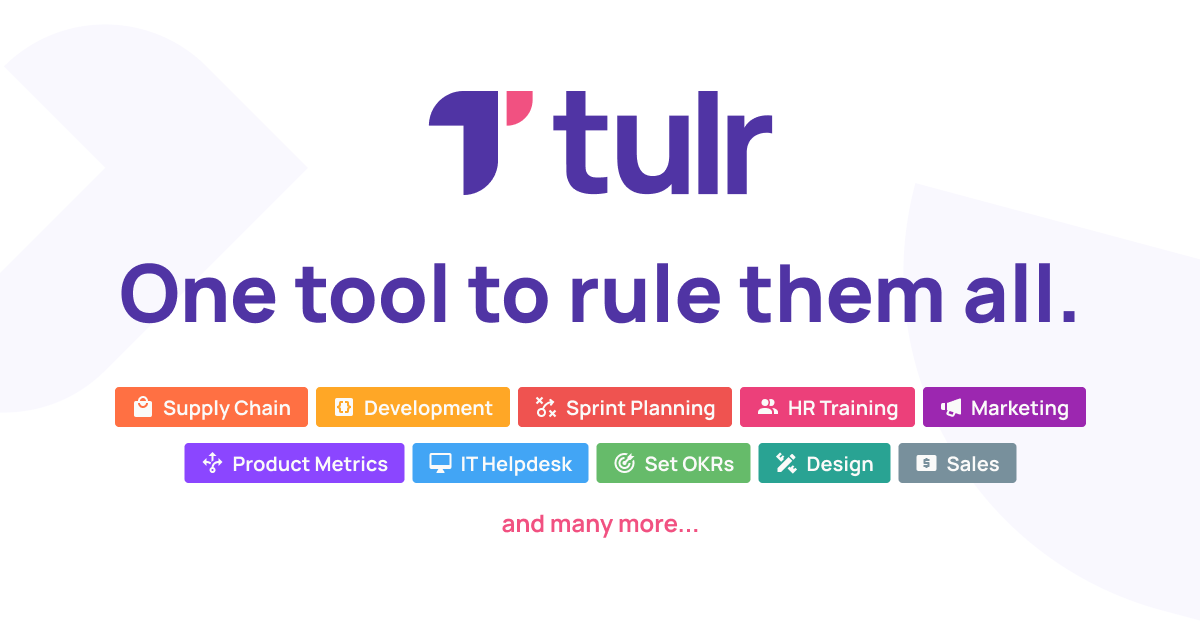
Tulr's pitch was subtraction: four tools, one workspace.
The problem
A new no-code platform had to explain, in one pass, why teams should stop duct-taping separate tools together.
My role
I designed the branding, UI motion, social assets, and the Product Hunt launch.
Approach
The one-tool positioning leads the story, with templates for applicant tracking, email marketing, and video pitches showing where it fits.
Key decisions
- 1Lead with consolidation—one workspace instead of four subscriptions.
- 2Show concrete templates so the promise is easy to picture.
- 3Use motion and social assets to carry the brand through launch.
Work status
Branding, UI animation, social media, and the Product Hunt launch.
The connecting thread
A design system built for scale.
The 700+ component library gave Tulr a consistent base across a fast-moving builder. A shared token and component language let seven developers ship different parts of the product without the interface drifting.
People I worked with
Shardul Lavekar was the direct partner on this work, alongside the engineering team at AuthMe Id Services.
- Shardul LavekarFounder
In retrospect
What shipped, and what stayed with me.
Work and releases
- Mobile and web no-code builder design.
- A 700+ component library with a shared base design system.
- Applicant tracking, email marketing, and video pitch templates.
- Branding, UI animation, social media, and Product Hunt launch.
Lessons learned
- 1Clarity of layout and hierarchy has to carry onboarding when there is no copilot to explain the product.
- 2A component library only pays off when it is treated as a product with states and documentation.
- 3Designing for non-technical makers means making the mental model visible on every screen.
Tulr shipped in the early no-code wave, before chat-native builders changed how makers expect to start.